Shallow moments in 2-D#
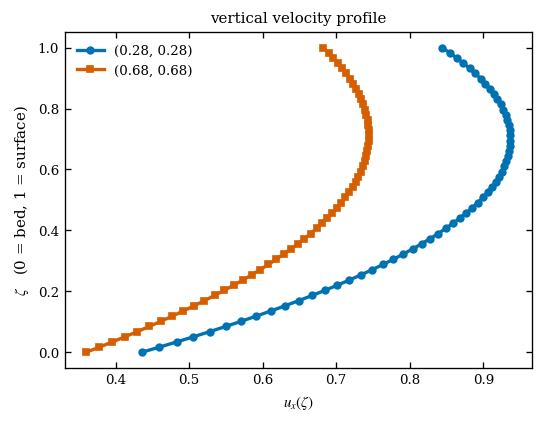
Shallow moments in 1-D recover the vertical structure of a 2-D flow; in 2-D they are essentially our 3-D model. The dimensionality is set by the mesh.
We write our own bed-drag closure, inject it into SME, and read the vertical
velocity profile back out.
1. A closure of our own#
A Closure declares what it closes and what it requires. For a bottom
closure the framework asks for the traction vector in the local frame
\(\{n, t_\alpha\}\) — one tangential entry per horizontal direction, coupled
through \(|u_t|\). Chézy-type quadratic drag, \(\tau_b = \rho\,C_d\,|u_b|\,u_b\):
import sympy as sp
from zoomy_core.model.models.closures import Closure


class ChezyBed(Closure):
    """Quadratic Chezy bed drag:  tau_b = rho * C_d * |u_b| u_b."""

    closes = "bottom"
    requires = ("u",)

    def register(self, m):
        m.parameter("C_d", 2.5e-3)

    def traction(self, s):
        speed = sp.sqrt(sum(ut ** 2 for ut in s.u_tangent))
        return {
            "normal": None,
            "tangent": [s.par.rho * s.par.C_d * speed * ut for ut in s.u_tangent],
        }
2. Build the model#
No subclass — closures and parameters are arguments. Both coefficients matter:
nu (bulk friction) is what shapes the profile, and the bed drag C_d is what
initiates the shear for it to act on. With either at zero there is no profile
to see. level=2 carries two moments beyond the depth average, enough for the
profile to have curvature rather than just a tilt.
import numpy as np

from zoomy_core.model.models import SME, Newtonian, StressFree
from zoomy_core.model.boundary_conditions import Extrapolation
from zoomy_core.model.initial_conditions import RP2d, Constant
from zoomy_core.systemmodel import SystemModel

sm = SystemModel.from_model(SME(
    level=2, dimension=3, quadrature_order=8,
    parameters={"nu": 0.1, "C_d": 0.5},
    closures=[Newtonian(), ChezyBed(), StressFree()],
    boundary_conditions=[Extrapolation(t)
                         for t in ("left", "right", "bottom", "top")],
))

high = np.zeros(len(sm.state)); high[1] = 2.0
low = np.zeros(len(sm.state)); low[1] = 1.0
sm.initial_conditions = RP2d(high=lambda n, h=high: h, low=lambda n, l=low: l,
                             jump_position_x=0.5, jump_position_y=0.5)
sm.aux_initial_conditions = Constant(constants=lambda n: np.zeros(n))

sm.describe()
SystemModel — 8 equations, 2 spatial dimensions
Parameters: \(g = 9.81\), \(\rho = 1.0\), \(\nu = 0.1\), \(\lambda_{s} = 0.0\), \(e_{x} = 0.0\), \(C_{d} = 0.5\)
System form:
State \(Q\):
Auxiliary \(Q_{aux}\):
Mass matrix \(M\):
Flux \(F\):
Hydrostatic pressure \(P\):
Diffusive flux \(A\) \(= 0\)
NCP \(B\)\(_{x}\):
NCP \(B\)\(_{y}\):
Source \(S\) (implicit):
Operations: from_model
3. Solve#
from zoomy_core.numerics import NumericalSystemModel, ReconstructionSpec
from zoomy_core.mesh import BaseMesh
from zoomy_core.fvm.solver_numpy import HyperbolicSolver
from zoomy_core.fvm import timestepping

nsm = NumericalSystemModel.from_system_model(
    sm, reconstruction=ReconstructionSpec(order=1))

mesh = BaseMesh.create_2d(domain=(0.0, 1.0, 0.0, 1.0), nx=20, ny=20)
solver = HyperbolicSolver(time_end=0.5,
                          compute_dt=timestepping.adaptive(CFL=0.45))
Q, _ = solver.solve(mesh, nsm, write_output=False)

n = mesh.n_inner_cells
Q = np.asarray(Q[:, :n], dtype=float)
h = Q[1]
2026-07-23 13:35:14.817 | INFO | zoomy_core.fvm.solver_numpy:run_simulation:1289 - iteration: 10, time: 0.023995, dt: 0.002311, next write at time: 0.500000
2026-07-23 13:35:15.144 | INFO | zoomy_core.fvm.solver_numpy:run_simulation:1289 - iteration: 20, time: 0.046722, dt: 0.002250, next write at time: 0.500000
2026-07-23 13:35:15.471 | INFO | zoomy_core.fvm.solver_numpy:run_simulation:1289 - iteration: 30, time: 0.069150, dt: 0.002241, next write at time: 0.500000
2026-07-23 13:35:15.799 | INFO | zoomy_core.fvm.solver_numpy:run_simulation:1289 - iteration: 40, time: 0.091624, dt: 0.002257, next write at time: 0.500000
2026-07-23 13:35:16.125 | INFO | zoomy_core.fvm.solver_numpy:run_simulation:1289 - iteration: 50, time: 0.114382, dt: 0.002293, next write at time: 0.500000
2026-07-23 13:35:16.451 | INFO | zoomy_core.fvm.solver_numpy:run_simulation:1289 - iteration: 60, time: 0.137543, dt: 0.002336, next write at time: 0.500000
2026-07-23 13:35:16.778 | INFO | zoomy_core.fvm.solver_numpy:run_simulation:1289 - iteration: 70, time: 0.161117, dt: 0.002375, next write at time: 0.500000
2026-07-23 13:35:17.104 | INFO | zoomy_core.fvm.solver_numpy:run_simulation:1289 - iteration: 80, time: 0.185057, dt: 0.002409, next write at time: 0.500000
2026-07-23 13:35:17.429 | INFO | zoomy_core.fvm.solver_numpy:run_simulation:1289 - iteration: 90, time: 0.209375, dt: 0.002451, next write at time: 0.500000
2026-07-23 13:35:17.754 | INFO | zoomy_core.fvm.solver_numpy:run_simulation:1289 - iteration: 100, time: 0.234110, dt: 0.002491, next write at time: 0.500000
2026-07-23 13:35:18.081 | INFO | zoomy_core.fvm.solver_numpy:run_simulation:1289 - iteration: 110, time: 0.259213, dt: 0.002525, next write at time: 0.500000
2026-07-23 13:35:18.408 | INFO | zoomy_core.fvm.solver_numpy:run_simulation:1289 - iteration: 120, time: 0.284609, dt: 0.002551, next write at time: 0.500000
2026-07-23 13:35:18.734 | INFO | zoomy_core.fvm.solver_numpy:run_simulation:1289 - iteration: 130, time: 0.310229, dt: 0.002570, next write at time: 0.500000
2026-07-23 13:35:19.061 | INFO | zoomy_core.fvm.solver_numpy:run_simulation:1289 - iteration: 140, time: 0.336014, dt: 0.002584, next write at time: 0.500000
2026-07-23 13:35:19.393 | INFO | zoomy_core.fvm.solver_numpy:run_simulation:1289 - iteration: 150, time: 0.361913, dt: 0.002594, next write at time: 0.500000
2026-07-23 13:35:19.723 | INFO | zoomy_core.fvm.solver_numpy:run_simulation:1289 - iteration: 160, time: 0.387891, dt: 0.002600, next write at time: 0.500000
2026-07-23 13:35:20.049 | INFO | zoomy_core.fvm.solver_numpy:run_simulation:1289 - iteration: 170, time: 0.413919, dt: 0.002604, next write at time: 0.500000
2026-07-23 13:35:20.380 | INFO | zoomy_core.fvm.solver_numpy:run_simulation:1289 - iteration: 180, time: 0.439978, dt: 0.002607, next write at time: 0.500000
2026-07-23 13:35:20.706 | INFO | zoomy_core.fvm.solver_numpy:run_simulation:1289 - iteration: 190, time: 0.466056, dt: 0.002609, next write at time: 0.500000
2026-07-23 13:35:21.038 | INFO | zoomy_core.fvm.solver_numpy:run_simulation:1289 - iteration: 200, time: 0.492150, dt: 0.002610, next write at time: 0.500000
2026-07-23 13:35:21.172 | INFO | zoomy_core.fvm.solver_numpy:run_simulation:1295 - Finished simulation with in 6.681 seconds
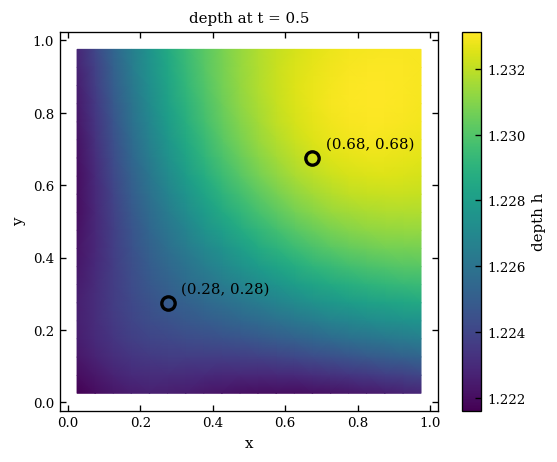
4. Depth, and two places to look#
import matplotlib.pyplot as plt
import zoomy_plotting as zp

centers = mesh.cell_centers_computed()
x, y = centers[0][:n], centers[1][:n]

probes = [(0.30, 0.30), (0.70, 0.70)]
cells = [int(np.argmin((x - px) ** 2 + (y - py) ** 2)) for px, py in probes]

with zp.apply_style():
    fig, ax = plt.subplots(figsize=(4.8, 3.9))
    tpc = ax.tripcolor(x, y, h, shading="gouraud", cmap=zp.CMAP_CONTINUOUS)
    fig.colorbar(tpc, ax=ax, label="depth h")
    for k in cells:
        ax.plot(x[k], y[k], "o", ms=8, mfc="none", mew=2, color="k")
        ax.annotate(f"({x[k]:.2f}, {y[k]:.2f})", (x[k], y[k]),
                    textcoords="offset points", xytext=(8, 6), fontsize=9)
    ax.set_xlabel("x"); ax.set_ylabel("y")
    ax.set_title(f"depth at t = {solver.time_end}")
    ax.set_aspect("equal")
    fig.tight_layout()
    plt.show()
5. The velocity profile there#
\(u(\zeta) = \sum_i (q_i/h)\,\phi_i(\zeta)\), with \(\zeta = 0\) the bed and
\(\zeta = 1\) the free surface. The bed drag holds the flow back at the bed and
the bulk friction carries that shear upwards — a depth-averaged model
(level=0) is a vertical line here.
from zoomy_core.model.derivation.basisfunctions import Legendre_shifted

LEVEL = 2
basis = Legendre_shifted(LEVEL)
zeta = np.linspace(0.0, 1.0, 60)

with zp.apply_style():
    fig, ax = plt.subplots(figsize=(4.6, 3.6))
    for k in cells:
        alpha = [Q[2 + j][k] / h[k] for j in range(LEVEL + 1)]   # q_x_0..q_x_2
        ax.plot(basis.reconstruct_velocity_profile(alpha, N=zeta.size), zeta,
                lw=2, label=f"({x[k]:.2f}, {y[k]:.2f})")
    ax.set_xlabel(r"$u_x(\zeta)$")
    ax.set_ylabel(r"$\zeta$   (0 = bed, 1 = surface)")
    ax.set_title("vertical velocity profile")
    ax.legend()
    fig.tight_layout()
    plt.show()